%20(Twitter%20Post).png)
Here’s the take nobody wants to say out loud: we are building the most expensive intelligence stack in history, and we still haven’t built the part that makes it pay off.
At Davos 2026, Jensen Huang framed this moment as “the largest infrastructure buildout in human history.” He’s not being poetic. He’s being literal. Power, land, GPUs, network, skilled labor, financing. This is an industrial cycle now, not a software trend.
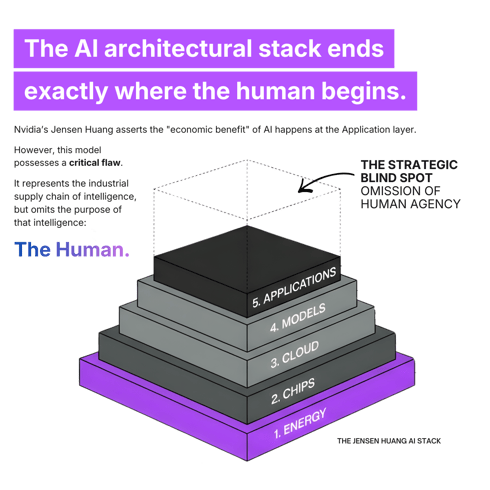
Jensen’s “five-layer cake” helps explain the supply chain: Energy → Chips → Cloud → Models → Applications. It’s clean. It’s correct. It’s also incomplete.
Because applications don’t create value. They create access. AI makes things correct. Humans make things connect.
And “connection” is where adoption happens, where trust forms, where decisions get made, and where ROI shows up.
 The 6th Layer: The Connection Layer
So yes, Jensen’s cake has five layers. But AI has six.
Layer 6 is the Connection Layer. It’s the last mile where output becomes something a human can stand behind, ship, and defend. It’s not another feature. It’s the moment a human commits to a version.
In creative work, this is painfully obvious. The final product often gets better when it gets less perfect. The breath stays in. The pause stays in. The take that is slightly messy but emotionally true wins. The grid gets broken on purpose. The moment lands because it feels human.
Models optimize toward polish. Creators optimize toward meaning.
That is the Connection Layer: where taste overrides optimization and “technically correct” becomes “relatable enough to matter.” If Layers 1 through 5 are the industrial supply chain of intelligence, Layer 6 is the supply chain of impact.
Energy and financing are raising the bar on “worth it”
The AI race has a new constraint: electricity.
Bloom Energy’s 2026 data center power reporting highlights a time-to-power reality that is colliding with hyperscaler assumptions, with timelines often 1.5 to 2 years longer than expected. The same report points to planning for gigawatt-scale campuses, which puts data centers in “power plant” territory.
The financing story says the same thing. The Washington Post reported a record $108.7B in bonds issued in Q4 to fund AI ambitions, treating this buildout like long-lived infrastructure. When the bond market becomes part of your AI supply chain, ROI can’t be a vibes-based strategy.
Here’s what this changes: when power becomes scarce and expensive, the definition of “AI value” gets stricter. Not benchmarks. Not demos. Outcomes. And outcomes are decided at Layer 6.
The interface is becoming the product
If the payoff lives in the Connection Layer, then the next battleground is not just model quality. It’s whether humans can translate intent into output they trust.
This is why vibe coding and voice interfaces matter. They compress the distance between what someone means and what gets built. They cut translation friction. They move AI closer to the moment a human commits.
Hot take inside the hot take: the interface is becoming the product, because the interface determines whether the human trusts the output enough to act. If the output isn’t trusted, it doesn’t matter how correct it is.
Cross-reference: decision systems are converging on the same “last mile”
In enterprise terms, Klover.ai frames a similar “last mile” idea as Point of Decision Systems (P.O.D.S.), designed to support human choice at decision time. I’m pointing at the same gravity well, but from a creative angle: the goal is not merely a decision, it’s connection. The version that ships is the one that feels human enough to land.
This is the shift we’re moving into: stop building replacement AI. Build connection-grade AI. Systems that help humans choose well, with taste, context, and accountability intact.
Conclusion: the sixth layer decides whether this era becomes a win or a write-off
Jensen’s five layers explain the buildout. They explain the constraint chain. They explain why this is infrastructure.
But they don’t explain the payoff.
The payoff doesn’t happen at applications. It happens when a human commits to a version and ships it.
AI makes things correct. Humans make things connect.
That is the sixth layer. And in 2026, it’s the layer that decides whether this infrastructure era becomes a generational win or a generational write-off.